
Sodium has become one of the biggest talking points in hydration.
Look at electrolyte products today and you'll see dramatically different numbers. Some provide a few hundred milligrams of sodium per serving. Others provide 500 mg, 1,000 mg or more.
That can make it seem like the product with the biggest sodium number must provide the best hydration.
But that's not how sodium balance works.
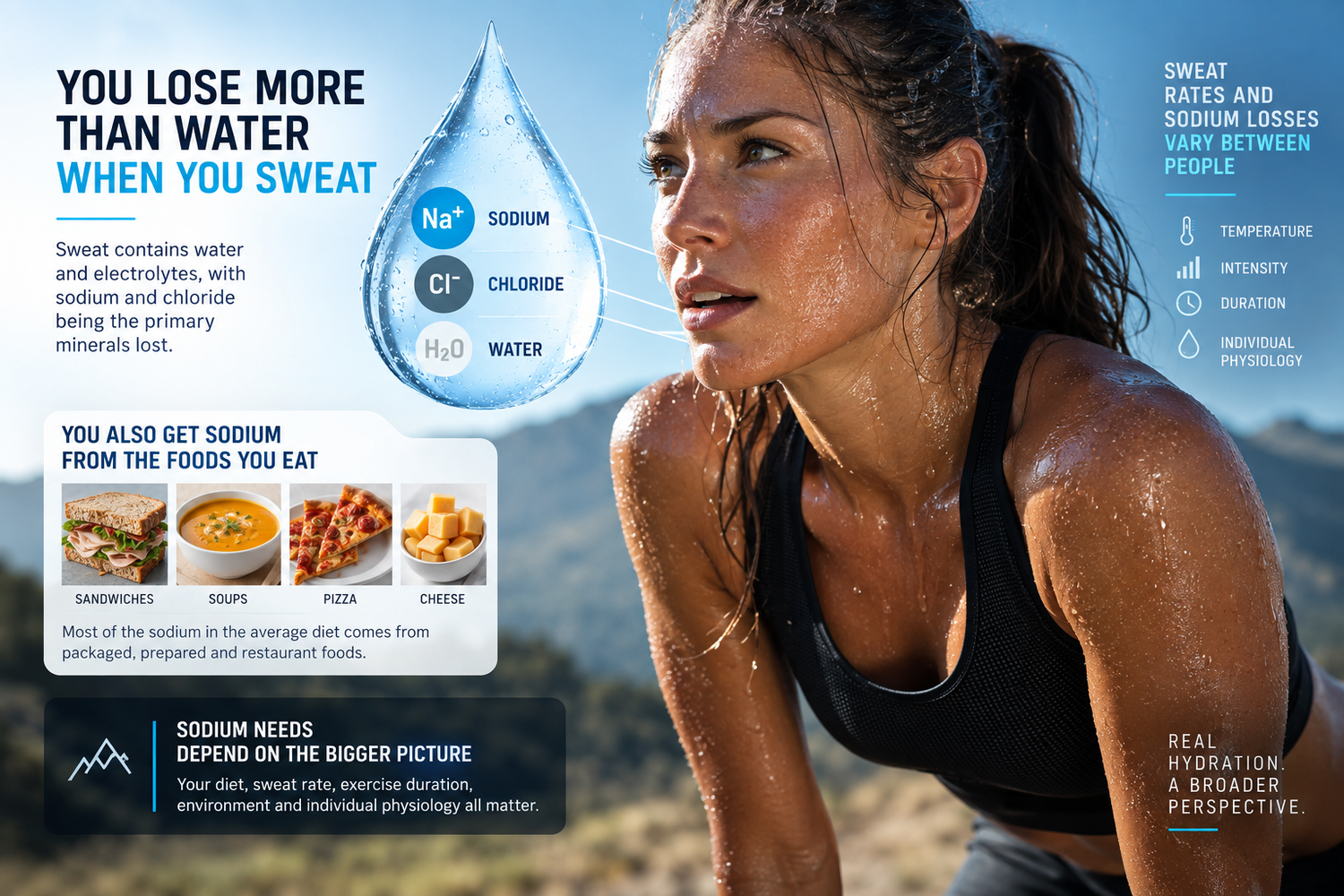
You don't start every workout with zero sodium in your body, and an electrolyte drink isn't your only source of sodium. You consume sodium throughout the day from the food you eat, while losing varying amounts through urine, sweat and other normal processes.
How much additional sodium you need for hydration therefore depends on the bigger picture: your diet, how much you sweat, how salty your sweat is, how long you're exercising, the environment you're exercising in and your individual physiology.
So how much sodium do you actually need?
Why Is Sodium Important for Hydration?
Sodium is the primary positively charged electrolyte in the fluid outside your cells. It plays an important role in maintaining fluid balance and supporting normal nerve and muscle function.
It's also one of the primary electrolytes lost when you sweat.
When exercise becomes longer, hotter or more intense, sweat losses can increase significantly. That means both water and sodium losses can increase too.
But the amount varies enormously between people.
The National Academies reports adult sweat sodium concentrations ranging from approximately 230 mg to 3,358 mg per liter, illustrating just how different two people's sweat can be. Sweat sodium concentration is influenced by factors including diet, sodium intake, sweat rate, heat exposure, acclimatization and exercise intensity.
That's why there isn't one sodium number that's right for everybody.
You Already Get Sodium From Food
This is an important part of the hydration conversation that's easy to overlook.
An electrolyte drink isn't your only source of sodium.
You consume sodium throughout the day from your diet.
Salt is sodium chloride, but sodium is also present in many other ingredients and foods. Bread, cheese, soups, sandwiches, pizza, poultry, deli meats, savory snacks and restaurant meals can all contribute to your daily sodium intake.
In fact, the FDA estimates that more than 70% of the sodium consumed in the United States comes from processed, packaged and prepared foods, rather than salt added during cooking or at the table.
That matters when talking about hydration.
Your body doesn't treat sodium from breakfast or lunch as irrelevant simply because it didn't come from an electrolyte drink. Dietary sodium contributes to your overall sodium status.
Sports-hydration guidance has long recognized this relationship. The American College of Sports Medicine has recommended beginning exercise with normal hydration and electrolyte status through a combination of normal meals and fluids, rather than treating hydration during exercise in isolation.
So when you see 300 mg, 500 mg or 1,000 mg of sodium on an electrolyte product, that isn't necessarily your total sodium intake. It's an additional amount on top of the sodium you're already consuming through your diet.
How Much Sodium Do You Lose Through Sweat?
Again, there isn't one number.
Your total sodium loss depends on two major variables:
How much you sweat × how much sodium is in your sweat.
Imagine two people exercising for an hour.
One loses half a liter of relatively low-sodium sweat. The other loses 1.5 liters of much saltier sweat.
Their sodium losses could be dramatically different even though they completed exactly the same workout.
Research shows sweat sodium concentration varies widely, while sweat rate itself changes with exercise intensity, temperature, humidity, acclimatization and individual physiology.
This is why universal statements such as “everyone needs 1,000 mg of sodium per hour” should be treated cautiously.
Some people may have substantial sodium requirements during prolonged exercise. Others may not.
Does Your Diet Replace Some of the Sodium You Lose?
Yes.
For many people, sodium consumed through normal food contributes substantially toward replacing everyday sodium losses.
The National Academies has specifically noted that sodium intake tends to increase as energy intake rises in physically active individuals and that this dietary increase is often enough to compensate for sweat sodium losses. It also recognizes an important exception: people who lose unusually large amounts of sodium through sweat may require additional sodium.
That's an important distinction.
Someone doing a 45-minute workout and then eating normal meals is in a very different situation from an endurance athlete competing for several hours in extreme heat.
The harder and longer you're sweating, the more important individual sodium replacement can become.
Do You Need Electrolytes Every Time You Exercise?
Not necessarily.
For shorter exercise sessions where sweat losses are relatively modest, water combined with a normal diet may be entirely adequate.
As exercise duration, heat and sweat losses increase, electrolyte replacement becomes more relevant.
The American College of Sports Medicine notes that electrolyte-containing beverages can provide benefits over water alone under certain exercise conditions and recommends individualized fluid-replacement strategies because both sweat rate and sweat electrolyte content vary considerably between people.
Electrolyte replacement may therefore become particularly useful when you're:
- Exercising for extended periods
- Training or competing in hot or humid conditions
- Sweating heavily
- Exercising multiple times in one day
- Trying to rapidly replace substantial fluid and electrolyte losses
- Someone who loses unusually high amounts of sodium through sweat
The context matters.
Is More Sodium Better?
Not automatically.
A hydration product containing 1,000 mg of sodium isn't inherently better than one containing 300 mg simply because the number is larger.
The relevant question is how much sodium you actually need in that situation.
Someone competing in an ultramarathon in hot weather may have very different requirements from someone going for a 30-minute run and then eating lunch.
The National Academies specifically recommends an individualized approach for people exposed to high physical activity and heat because of the considerable variability in sweat and sodium losses.
So comparing hydration products solely by asking “Which one has the most sodium?” misses much of the physiology.
More isn't automatically better.
The appropriate amount depends on what you're losing and what you're already consuming.
Why Does SHARKBITE Contain 300 mg of Sodium?
SHARKBITE provides 300 mg of sodium per serving.
We didn't formulate SHARKBITE around trying to put the biggest possible sodium number on the front of the package.
We designed it as a broader hydration formula.
Each serving contains all six electrolytes:
Sodium • Potassium • Magnesium • Calcium • Chloride • Phosphorus
Sodium remains an important part of that formula, but it isn't the entire formula.
And importantly, those 300 mg don't exist in isolation.
They're part of your overall sodium intake, which also includes the sodium you consume through food.
For many everyday activities and workouts, we believe a moderate amount of sodium makes more sense for the way SHARKBITE is designed to be used than simply chasing an increasingly large number.
At the same time, someone experiencing exceptionally high sweat and sodium losses during prolonged endurance exercise may have greater individual requirements.
That's not a contradiction. It's exactly why hydration should be considered in context.
Sodium Doesn't Work in Isolation
Sodium gets most of the attention, but your body uses multiple electrolytes.
Chloride works closely with sodium and is also a major component of sweat.
Potassium is the primary positively charged electrolyte inside cells and contributes to normal fluid balance, muscle function and nerve signaling.
Magnesium and calcium contribute to normal muscle and nerve function, while phosphorus, primarily present in the body as phosphate, plays important roles in cellular processes and energy metabolism.
That's why SHARKBITE includes all six electrolytes rather than treating hydration as a competition to put the largest sodium number on a package.
What About Sodium and Glucose?
There's another interesting part of sodium physiology.
In the small intestine, sodium and glucose can be transported together through a protein called SGLT1, or sodium-glucose cotransporter 1.
This sodium-glucose transport mechanism is an important part of the physiology underlying oral rehydration.
SHARKBITE contains 1.5 grams of cane sugar per serving alongside its 300 mg of sodium.
We explore that mechanism separately in our article:
Why Is There Sugar in Electrolyte Drinks?
It's another example of why looking at one number or ingredient in isolation doesn't tell you the whole story.
Can You Consume Too Much Sodium?
Yes.
Sodium is essential, but essential doesn't mean unlimited.
For the general population, diets higher in sodium are associated with increased risk of high blood pressure, which is a major risk factor for heart disease and stroke.
At the same time, someone losing substantial sodium through prolonged sweating can have very different short-term requirements.
The National Academies specifically recognizes that people exposed to high temperatures or high levels of physical activity may require greater sodium intake because of increased sweat losses.
Both things can be true.
That's why your total diet, activity, environment and sweat losses matter.
How Do You Know How Much Sodium You Need?
For most recreational activity, you probably don't need to calculate your sodium balance down to the milligram.
Think about the bigger picture:
What are you taking in?
You're consuming sodium through food and beverages throughout the day.
What are you losing?
Exercise increases sweat losses, and both the amount of sweat and its sodium concentration vary between individuals.
For someone exercising recreationally for a relatively short period, the equation can be quite different from an endurance athlete sweating heavily for several hours.
Athletes with unusually high sweat losses, people exercising for extended periods in extreme heat or those who regularly see substantial salt deposits on their clothing or skin may benefit from a more individualized hydration strategy.
One simple way to estimate fluid losses is to compare body weight immediately before and after exercise while accounting for fluid consumed. More detailed sweat testing can help estimate sodium concentration for athletes who genuinely need that level of precision. ACSM similarly recommends customized fluid-replacement programs because of the substantial person-to-person variability in sweat losses.
The Bottom Line
Sodium matters for hydration. But more sodium doesn't automatically mean better hydration.
You already consume sodium through the food you eat. When you exercise, you lose varying amounts through sweat. How much additional sodium makes sense depends on the balance between what you're consuming and what you're losing.
For many people, normal dietary sodium contributes substantially to maintaining sodium balance. For people experiencing large sweat losses, prolonged exercise or extreme heat, additional sodium can become increasingly important.
SHARKBITE provides 300 mg of sodium per serving, alongside potassium, magnesium, calcium, chloride and phosphorus as part of its six-electrolyte formulation.
Instead of choosing a hydration product simply because it has the biggest sodium number on the package, ask a better question:
Does the formulation make sense for what I'm actually doing?
That's a much more useful way to think about hydration.