

Most people have been taught to think of sugar in a hydration drink as something negative.
Walk down the hydration aisle today and you'll see plenty of products competing to advertise “zero sugar” as prominently as possible.
But the relationship between sugar and hydration is more complicated than that.
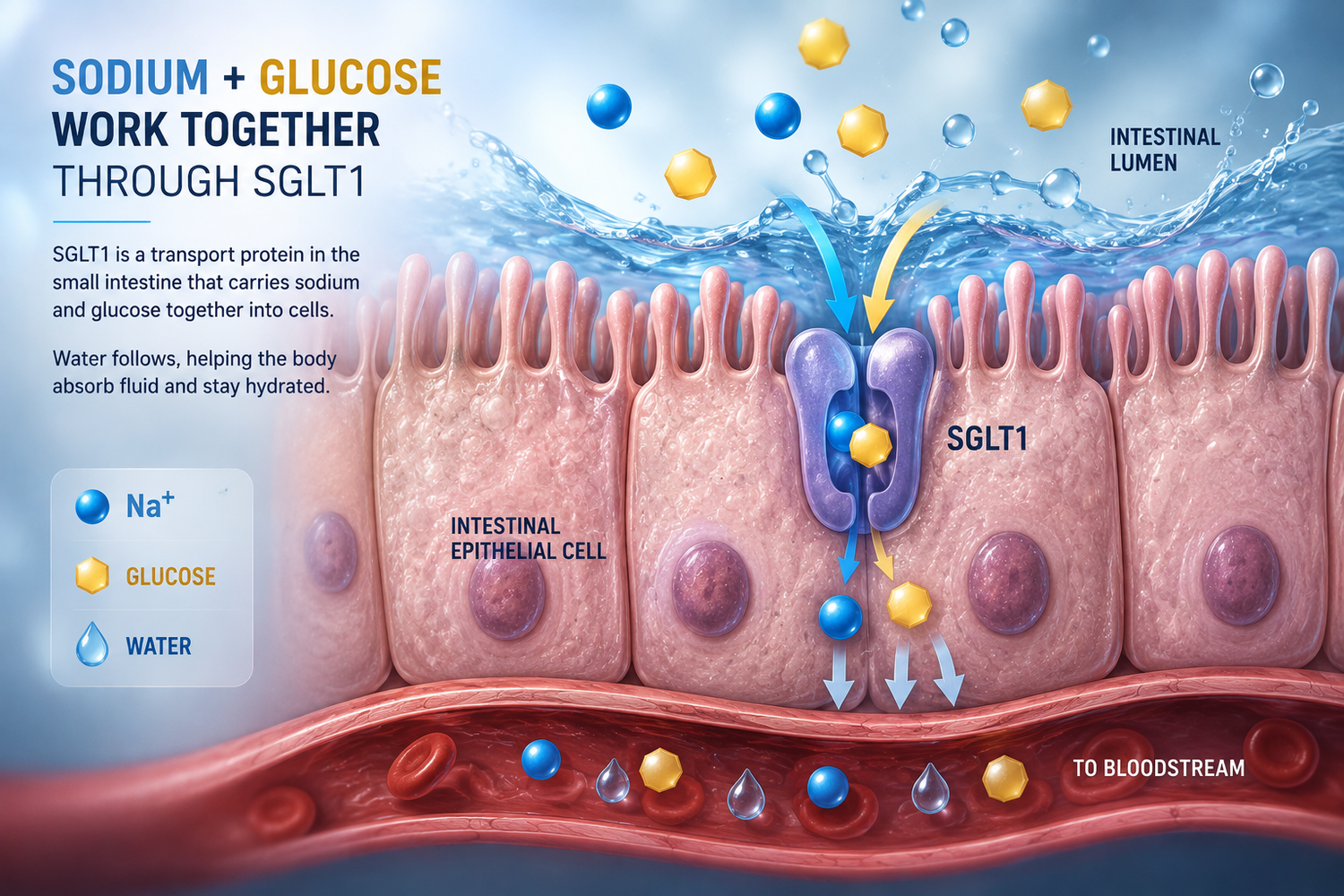
A small amount of glucose can play a functional role in intestinal fluid absorption because of a transport mechanism called SGLT1, which moves sodium and glucose together across the intestinal wall.
So why is sugar used in electrolyte drinks, how does this mechanism work, and does that mean more sugar is better?
Why Is Sugar Added to Electrolyte Drinks?
Sugar can serve several purposes in a sports or electrolyte drink.
It can provide carbohydrate for energy, improve taste and, when glucose is present alongside sodium, participate in the intestinal transport process involved in fluid absorption.
For hydration specifically, the important relationship is between glucose, sodium and water.
This isn't a new discovery or a marketing theory. The sodium-glucose transport mechanism is fundamental to the science behind oral rehydration solutions used around the world.
What Is SGLT1?
SGLT1 stands for sodium-glucose cotransporter 1.
It is a transport protein found in the lining of the small intestine.
Rather than sodium and glucose being absorbed completely independently, SGLT1 can transport them together from the intestine into intestinal cells.
Water follows the absorption of these solutes, helping facilitate fluid uptake.
Put simply:
Sodium + glucose → intestinal transport → water absorption
This mechanism is one reason combinations of sodium and glucose have been used so effectively in oral rehydration solutions.
Does That Mean You Need Sugar to Hydrate?
No.
Your body can absorb water without drinking sugar, and for normal day-to-day hydration, water and a balanced diet may be entirely sufficient.
The point isn't that you can't hydrate without sugar.
It's that glucose and sodium have a well-established physiological relationship in the small intestine, and this relationship can be useful when formulating hydration products.
That's a very different claim.
Is Zero-Sugar Hydration Bad?
Not necessarily.
Zero-sugar electrolyte products can still provide water and electrolytes, and there are plenty of situations where someone may prefer a drink without sugar.
The problem comes when “zero sugar” automatically gets interpreted as “better hydration.”
Those are not the same thing.
Removing sugar may reduce calories and carbohydrates, but the absence of sugar itself doesn't prove that a product hydrates better.
Likewise, simply adding sugar doesn't automatically make a hydration product better.
What matters is the formulation as a whole and what the product is intended to do.
Is More Sugar Better for Hydration?
Definitely not.
This is another important distinction.
The fact that glucose participates in sodium-glucose cotransport does not mean increasing the amount of sugar indefinitely will improve hydration.
Highly concentrated carbohydrate solutions can behave differently in the gastrointestinal tract, and sports drinks designed to deliver significant carbohydrate have different objectives from products primarily designed around hydration.
So the useful question isn't:
“Does it contain sugar?”
It's:
“Why is the sugar there, and how much is being used?”
Why Does SHARKBITE Contain 1.5g of Cane Sugar?
When developing SHARKBITE, we didn't want to remove sugar simply because “zero sugar” looked better on the front of a package.
We also didn't want to load the formula with unnecessary sugar.
Instead, SHARKBITE contains a deliberately small amount:
1.5 grams of cane sugar per serving.
That small amount sits alongside 300 mg of sodium and SHARKBITE's six-electrolyte profile.
The cane sugar isn't there simply to make the product sweet. It provides glucose, which can participate in sodium-glucose cotransport through SGLT1.
At the same time, we're careful not to claim that 1.5 grams is some universally perfect amount or that it makes SHARKBITE automatically hydrate faster than every zero-sugar product. Human hydration is more complicated than a single ingredient or mechanism.
It's simply part of the reasoning behind the formulation.
Why Cane Sugar?
Cane sugar is primarily sucrose.
During digestion, sucrose is broken down into glucose and fructose. The glucose component can then participate in SGLT1-mediated transport alongside sodium.
That distinction is important because SGLT1 transports glucose, not intact sucrose.
SHARKBITE uses cane sugar as part of the overall formulation rather than relying on large quantities of carbohydrate.
What About Artificial Sweeteners?
Sweetness and glucose transport are two separate issues.
A non-caloric sweetener may make a drink taste sweet, but sweetness itself doesn't provide glucose.
SHARKBITE uses Rebaudioside M (Reb M) alongside the small amount of cane sugar, allowing the formula to achieve sweetness without needing a large sugar load.
The 1.5 grams of cane sugar therefore has a different role from the high quantities of sugar historically found in many traditional sports drinks.
The Bottom Line
Sugar isn't automatically good or bad for hydration.
The physiology is more interesting than that.
Glucose and sodium can be transported together through SGLT1 in the small intestine, a mechanism that contributes to intestinal water absorption and underpins the science of oral rehydration.
That doesn't mean every hydration drink needs a large amount of sugar. And it certainly doesn't mean more sugar equals better hydration.
At SHARKBITE, we use 1.5 grams of cane sugar alongside 300 mg of sodium and all six electrolytes as part of a deliberately formulated hydration system.
Instead of asking whether an electrolyte drink contains sugar, it may be more useful to ask:
Why is it there?
For us, every ingredient should have a reason